How does Alkira simplify networking challenges during mergers and acquisitions (M&A)?
Alkira's Cloud Networking as a Service (CNaaS) provides a unified, cloud-native platform that addresses the complex networking challenges of M&A, such as integrating disparate networks, resolving overlapping IP addresses, and ensuring secure, scalable connectivity across multiple clouds and on-premises environments. Alkira enables rapid onboarding of workloads, seamless policy-driven traffic inspection, and resource sharing, all while reducing operational complexity and costs. Learn more.
What specific M&A pain points does Alkira address?
Alkira addresses key M&A pain points including:
CapEx and OpEx Overhead: Reduces infrastructure and licensing costs by consolidating and optimizing network and security footprints.
Operational Complexity: Simplifies integration of different vendors, tools, and skill sets with a single, intuitive platform.
Data Integration: Enables seamless connectivity for application migration, data center consolidation, and shared services.
Overlapping IP Addresses: Resolves IP conflicts using advanced NAT policies at Alkira Cloud Exchange Points (CXPs).
Security: Integrates next-generation firewalls and Zero Trust Network Access (ZTNA) for secure traffic flows between merged entities.
Shared Services: Facilitates access to shared IT services (e.g., AD, DNS, NTP) across merged organizations.
What results have customers achieved using Alkira for M&A integration?
Customers have realized dramatic improvements in M&A network integration timelines and efficiency. For example:
Koch Industries: Recreated over two years of network integration work in a single afternoon using Alkira.
Chart Industries: Rapidly integrated 90 additional sites, reducing deployment timelines from 3-6 months to days.
Unified multicloud connectivity: Achieved seamless integration across AWS, Azure, and Google Cloud, including disparate SD-WAN technologies, with significant cost reductions. Read the full case study.
Features & Capabilities
What are the key features of Alkira's platform for M&A and enterprise networking?
Alkira offers:
Network Infrastructure-as-a-Service (NIaaS): On-demand, hardware-free networking for hybrid and multicloud environments.
Global Backbone-as-a-Service: Scalable, low-latency connectivity across geographies, reducing deployment times from months to minutes.
Integrated Security: Zero Trust Network Access (ZTNA), next-generation firewalls, and policy-driven traffic inspection.
Segmentation: Isolates workloads and enables granular policy enforcement for merged organizations.
Advanced Overlapping IPs Solution: Resolves IP conflicts using NAT policies at Alkira CXPs.
Resource Sharing: Enables secure, policy-based access to shared IT services across segments.
Automation with Terraform: Supports large-scale, automated network provisioning.
Single-pane-of-glass visibility: Centralized monitoring and management tools.
How does Alkira handle overlapping IP addresses during mergers?
Alkira's Cloud Exchange Points (CXPs) allow for overlapping IP spaces by applying network-wide policies, including NAT, to resolve conflicts. This enables seamless connectivity between merged organizations without requiring major readdressing or manual configuration. Learn more.
How does Alkira support segmentation and isolation for merged companies?
Alkira enables segmentation by creating unique routing and policy spaces (segments) within its platform. This allows merged companies to isolate workloads, inspect traffic between segments, and maintain compliance and security boundaries as needed. Read more.
What integrations does Alkira offer with third-party security and networking solutions?
Alkira integrates with leading technology providers, including:
Does Alkira provide APIs for integration and automation?
Yes, Alkira offers APIs, including billing APIs that provide real-time cloud network cost data for integration with cost management tools and dashboards. These APIs support automated monitoring and optimization of cloud costs. Learn more.
Security & Compliance
How does Alkira ensure security and compliance for M&A and enterprise networking?
Alkira is SOC 2 and PCI-DSS compliant, demonstrating robust operational controls and protection of sensitive data. The platform integrates advanced security features such as Zero Trust Network Access (ZTNA) and next-generation firewalls, ensuring secure connectivity for distributed workforces and applications. Customers are encouraged to manage user access and follow security best practices. More on Alkira's compliance.
How does Alkira provide secure connectivity across multiple clouds during M&A?
Alkira delivers secure, policy-driven connectivity across AWS, Azure, Google Cloud, and on-premises environments. Integrated security features, such as ZTNA and next-gen firewalls, protect traffic flows between merged entities and across cloud providers, reducing vulnerabilities associated with traditional VPNs and perimeter-based models.
Implementation & Ease of Use
How quickly can Alkira be implemented for M&A network integration?
Alkira enables rapid implementation:
Proof of concept can be set up in as little as 4 hours.
Full production deployment typically takes about 8 weeks.
The platform's drag-and-drop interface and automation tools make onboarding straightforward, even for complex M&A scenarios. Explore Alkira's training resources.
What feedback have customers shared about Alkira's ease of use?
Customers consistently praise Alkira for its intuitive interface and rapid deployment:
"The IT DIY approach was going to take 6 months to be secure and redundant and all. Alkira did it for us in 3 days, and at very low cost." – Network Architect, Large Manufacturer
"We met with Alkira, and after about an hour of us explaining what we needed, we created a POC – and stood that up in a morning. Design-to-POC-setup in about 4 hours." – Sr. Director, Network Architect, Financial Company
"We had gone from a mass of complexity and months of work to a dashboard that allowed us simply to draw our network and deploy it in a few hours." – Matt Hoag, CTO at Koch Industries
What training and support resources are available for new Alkira customers?
Alkira provides:
A dedicated training platform with detailed guidance, demos, and resources (Alkira Training Platform).
24×7 monitoring and proactive notifications for maintenance and upgrades.
Dedicated support via [email protected] and a diagnostics dashboard for live troubleshooting.
These resources ensure a smooth onboarding and operational experience.
Pricing & Plans
What is Alkira's pricing model?
Alkira offers flexible pricing options:
Consumption-Based Pricing: Pay-as-you-go based on actual usage of network elements, services, and bandwidth.
Commitment-Based Pricing: Fixed pricing for predictable budgeting.
Pricing is determined by the quantity and size of network elements (e.g., Alkira Cloud Exchange Points), connectors, firewalls, and data egress. Customers can view live pricing details from the portal or via APIs. See Alkira's Pricing Page.
Competition & Comparison
How does Alkira compare to other cloud networking solutions for M&A?
Alkira differentiates itself by offering:
True Abstraction Layer: Leverages cloud providers' infrastructure for end-to-end solutions, eliminating manual configurations and enabling single-click provisioning.
Integrated Security: Built-in ZTNA and next-gen firewalls for secure, policy-driven access.
Vendor-Agnostic Approach: Allows free choice of security and network stack components, avoiding vendor lock-in.
Rapid Deployment: Reduces integration timelines from months to days.
Compared to competitors:
Aviatrix: Focuses on orchestration overlays and requires deep cloud expertise; Alkira provides a unified, easy-to-use abstraction layer.
Prosimo: Application-centric, limited in traditional network use cases; Alkira addresses both cloud and traditional scenarios.
Nefeli: Agent-based, requires manual configuration; Alkira automates routing and provides a unified platform.
Cato: SD-WAN focused, limited multi-cloud support; Alkira offers global backbone-as-a-service for multi-cloud and hybrid environments.
What are some real-world use cases and industries where Alkira has delivered value?
Alkira has delivered measurable value across industries including manufacturing, retail, healthcare, telecommunications, financial services, biotechnology, software technology, media & entertainment, and aviation. Notable case studies:
Michaels: Transformed its network across 1,400 stores in record time.
Alkira is designed for mid-to-large enterprises across diverse industries. Key roles include Network Architects, Cloud Architects, Security Architects, IT Managers/Directors, CloudOps, as well as business leaders such as VPs, CTOs, CIOs, and CISOs. The platform is tailored for both technical and business decision-makers seeking to simplify and accelerate cloud networking and M&A integration.
Technical Documentation & Resources
What technical documentation and resources are available for Alkira?
These services minimize downtime and ensure smooth operations for customers.
Company & Vision
What is Alkira's vision and mission?
Alkira's vision is to transform enterprise connectivity by simplifying cloud networking for the AI era. Its mission is to eliminate the complexity of traditional hardware-dependent networking by providing a cloud-native solution that seamlessly connects hybrid and multi-cloud environments through a unified control plane. Learn more about Alkira.
What recognition and awards has Alkira received?
Alkira has been recognized as a Gartner Cool Vendor, named among America’s Best Startup Employers by Forbes, and received the 2024 Excellence Award from Cloud Computing Magazine. It was also listed on CRN’s 2023 Stellar Startups List and ranked 25th fastest-growing company in North America on the 2024 Deloitte Technology Fast 500™. See more company details.
Mergers and Acquisitions (M&A) made easy with Cloud Networking as a Service
Summarize with AI
Mergers and acquisitions (M&A) are common in the enterprise world. M&A is a complex process, whether you look at it from a technological, legal, cultural, or organizational perspective.
Here is the list of challenges enterprises face after the merger and acquisition:
When two companies are merged, the IT organizations of each company need to think about the increased footprint and how to manage expenses/costs associated with the networking and security infrastructure, which include license costs for different software vendors and networking infrastructure costs.
2- Operational Complexity
With any M&A activity, IT organizations have a challenge regarding what kind of software, hardware, or tools are being used for networking and security needs; this also requires the right skill set to manage the infrastructure. Since two companies could be using different vendors/tools for their IT needs, this creates a challenge for these companies to have the right skill set to manage the infrastructure.
3- Data Integration
Bringing together corporate data from two organizations is one of the most critical and challenging aspects of IT integration during an M&A deal. This process is essential for application migration, maintenance or upgrade activities, data center migrations, and website consolidation.
Technical Challenges
The most important thing for enterprises after the merger is assimilating email domains, directory services, address lists, calendar sharing, etc., to run a company seamlessly and effectively for all users and give access to up-to-date information.
When companies merge, the acquiring business has to expand the IT footprint of the merging business, which can uncover weaknesses in its cybersecurity infrastructure.
With traditional non-cloud mergers and acquisitions of firms, companies may need to move equipment and servers to new office locations and plan to purchase more servers to compensate for the additional employees. Connecting to a traditional on-site server system via VPN could have been faster and riddled with security issues.
Technical Requirements
The following requirements can be summarized from the challenges mentioned above:Figure 1: Connectivity between Merged Companies for On-premise and cloud environments using CSP (Cloud Service Provider) Transit
Connectivity Between Merging Enterprises across Multiple Clouds
Merging Enterprise companies have cloud and hybrid environments that connect applications to the users. Depending on the Cloud Service Providers being used for hosting the applications, these companies need to consider connectivity options for seamless communication.
Overlapping IP addresses
Before mergers, these companies were designed independently, and network administrators used the private RFC 1918 space to build these networks; hence there is a high possibility that the IP scheme used in the networks is the same. This requires a solution to overcome this overlapping IP address problem.
Security
After an M&A, one of the requirements is to provide security for the traffic flows between the two enterprises. This requires considering how to insert firewalls to provide security and considering different cloud networks across CSPs. Another requirement would be to consolidate and cost reduction for the security footprint.
Shared Services
Merging entities with IT services such as Microsoft AD, CDN, DNS, NTP, or DHCP services are hosted in a shared VPC/VNET and must be accessed from on-prem and their third-party vendors. When the merger happens, network connectivity for these services is required.
Alkira Solution for M&A
Alkira Cloud Networking is the first global unified multi-cloud network delivered as a service. Alkira seamlessly solves all the network requirements and challenges mentioned above for merged entities.
Alkira allows M&A customers to use a One Architecture approach to quickly onboard their cloud workload (VPCs, VNETs, VCNs etc.) to the Alkira Cloud Exchange Points (CXPs) and consolidate or optimize their infrastructure footprint. Alkira CNaaS offers the same approach for connecting on-premise infrastructure to Alkira CXPs by leveraging various methods, including AWS Direct Connect, Azure Express Routes, and IPsec/SD-WAN Connections from their DCs and branches.
Alkira’s solution also allows customers who would like to inspect the traffic between on-premise to cloud or multi-cloud environments to use a policy-driven framework to inspect traffic as per the requirements.Figure 2: Alkira Topology showing connectivity options using multiple segments for Merged CompaniesFigure 3: Alkira Topology showing connectivity options advanced NAT capabilities for Merged Companies
Alkira Solution Benefits
Segmentation
Alkira can provide isolation of workloads and communication for merging enterprise companies. Traffic across segments can be inspected as well. Since a segment represents a unique routing and policy space, maintaining isolation becomes seamless for customers. Merged companies can isolate workloads by using different segments on the Alkira CXP.
Alkira provides seamless integration with vendors like Fortinet,Check Point and Palo Alto or traffic inspection for any type of traffic flow. Merged entities get a significant advantage as they don’t have to bring up firewalls depending on traffic flow. Also, functionality like autoscaling comes as part of the solution, which helps to scale up or down depending on the requirements.
The Alkira CXPs or cloud exchange points form a networking fabric in the cloud that you can connect to on-premise sites like SD-WAN or standard IPsec sites or private connectivity options such as Direct Connect and Express Route connect your cloud networks using native constructs. Once these on-prem sites and cloud networks like VPC or VNets are connected to the Alkira CXPs – where overlapping IP spaces are allowed, Alkira’s policies can be applied network-wide to them, and part of the policy is NAT.Hence any resources which have overlapping IP addresses can be handled via NAT.
Using the Alkira solution, customers can use the Resource Sharing feature to handle the shared services use case. Resource sharing allows them to choose specific resources by identifying the network prefixes to be shared across two segments and enabling additional capability to allow an inline firewall to inspect the traffic for Resource sharing.
For more details, please check out our blog on resource sharing.
Automation with Terraform
Network Infrastructure deployment at a large scale requires automation, and Alkira helps to solve this, wherein the customer can use terraform to provision the network infrastructure for Alkira.
Conclusion
Alkira Cloud Area Networking infrastructure provides companies going through M&A activities with an easy and secure solution with all technical requirements.
Schedule a demo today to see how Alkira can help accelerate your Mergers and Acquisitions (M&A) made easy with Cloud Networking as a Service.
Ahmed Abeer is a Sr. Product Manager at Alkira, where he is responsible for building a best-in-class Multi-Cloud Networking and Security Product. He has been in Product Management for more than ten years in different big and small organizations. He has worked with large enterprise and service provider customers to enable LTE/5G MPLS network infrastructure, automate Layer 3 Data Center, enable Next-Gen Multi-Cloud architecture, and define customers' Multi-Cloud strategies. Ahmed's technical expertise in Cloud Computing and Layer 2/Layer 3 network technologies. Ahmed is a public speaker at various conferences & forums and holds a Master's Degree in Computer Engineering.
DK
About the author
Deepesh Kumar
Deepesh Kumar is a Solutions Architect and product specialist in the computer networking industry with over 8 years of experience. He currently works as part of the post sales team at Alkira and focuses on working with customers to design and deploy the Alkira solution. Prior to working here, he worked at Viptela which was acquired by Cisco Systems. He holds a masters degree from San Jose State University.
Enterprise networks are expected to run 24/7, and the teams responsible for them need visibility wherever work happens. Cloud environments, partner connections, security services, and provisioning workflows are constantly changing. When something needs attention, network and operations teams need a fast way to understand what happened, assess impact, and take the right next step. That...
Enterprises are moving quickly on AI, but many are still running networking models designed for a slower, more centralized and static era. Today’s network has to connect clouds, data centers, campuses, branches, partner environments, and increasingly private AI infrastructure while enforcing consistent policy across all of it. That creates a new operational reality: every new...
The Digital Operational Resilience Act (DORA) is reshaping how financial institutions in the European Union manage operational risk related to information and communication technology (ICT). As the regulation takes effect, organizations must ensure that their critical ICT service providers support strong operational resilience, risk management, and oversight capabilities. For technology providers supporting financial institutions, this...


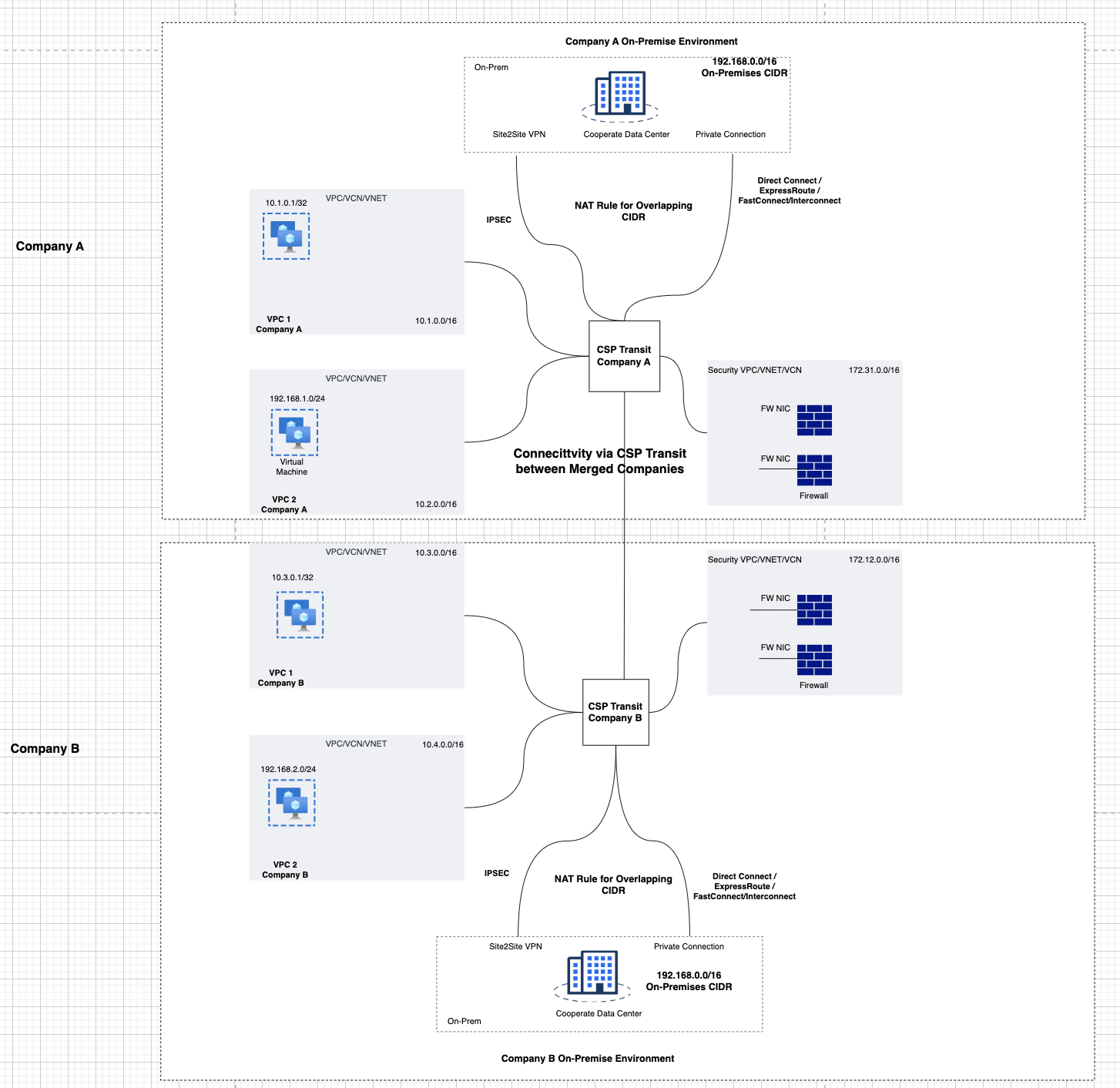 Figure 1: Connectivity between Merged Companies for On-premise and cloud environments using CSP (Cloud Service Provider) Transit
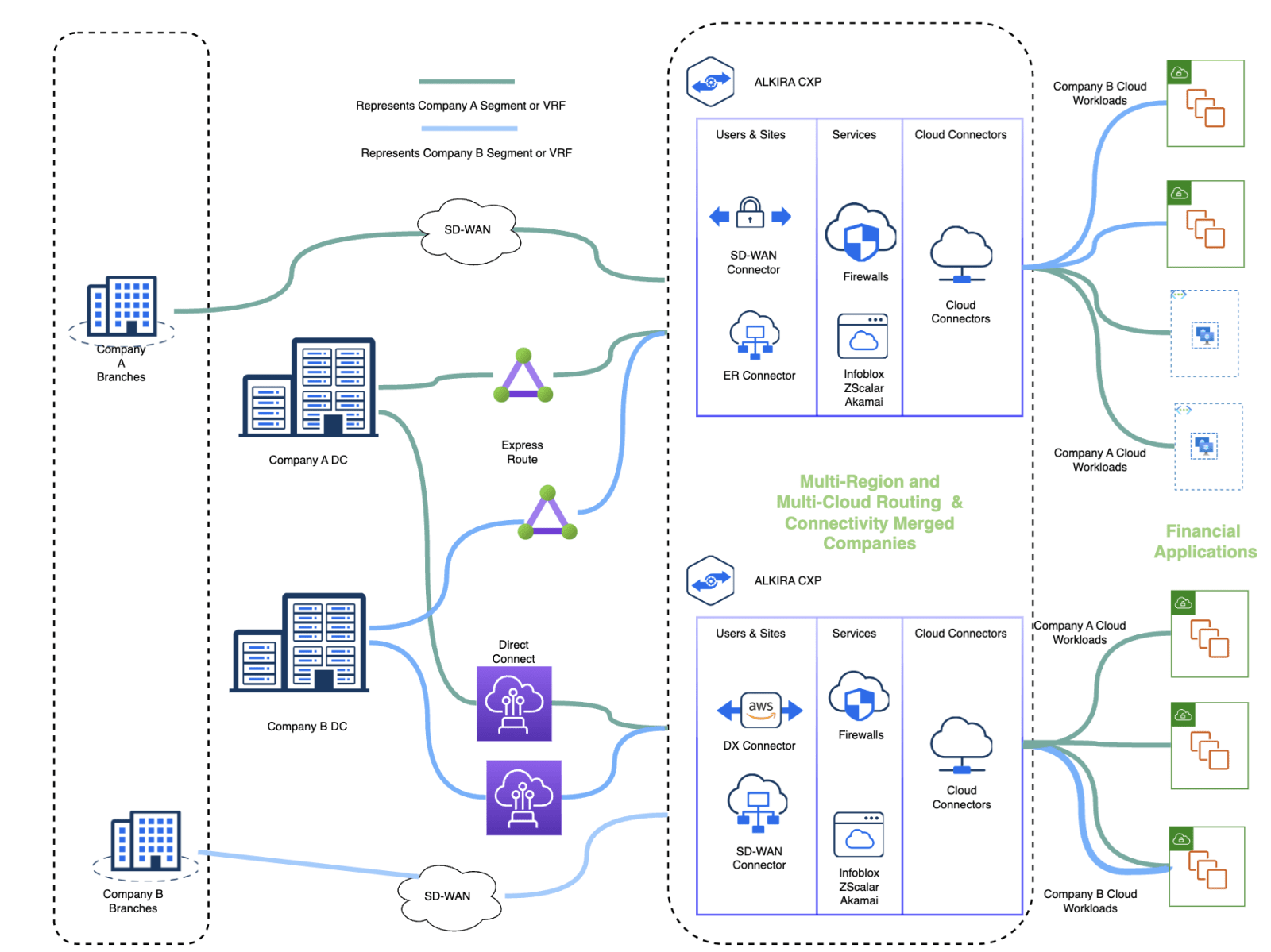 Figure 2: Alkira Topology showing connectivity options using multiple segments for Merged Companies
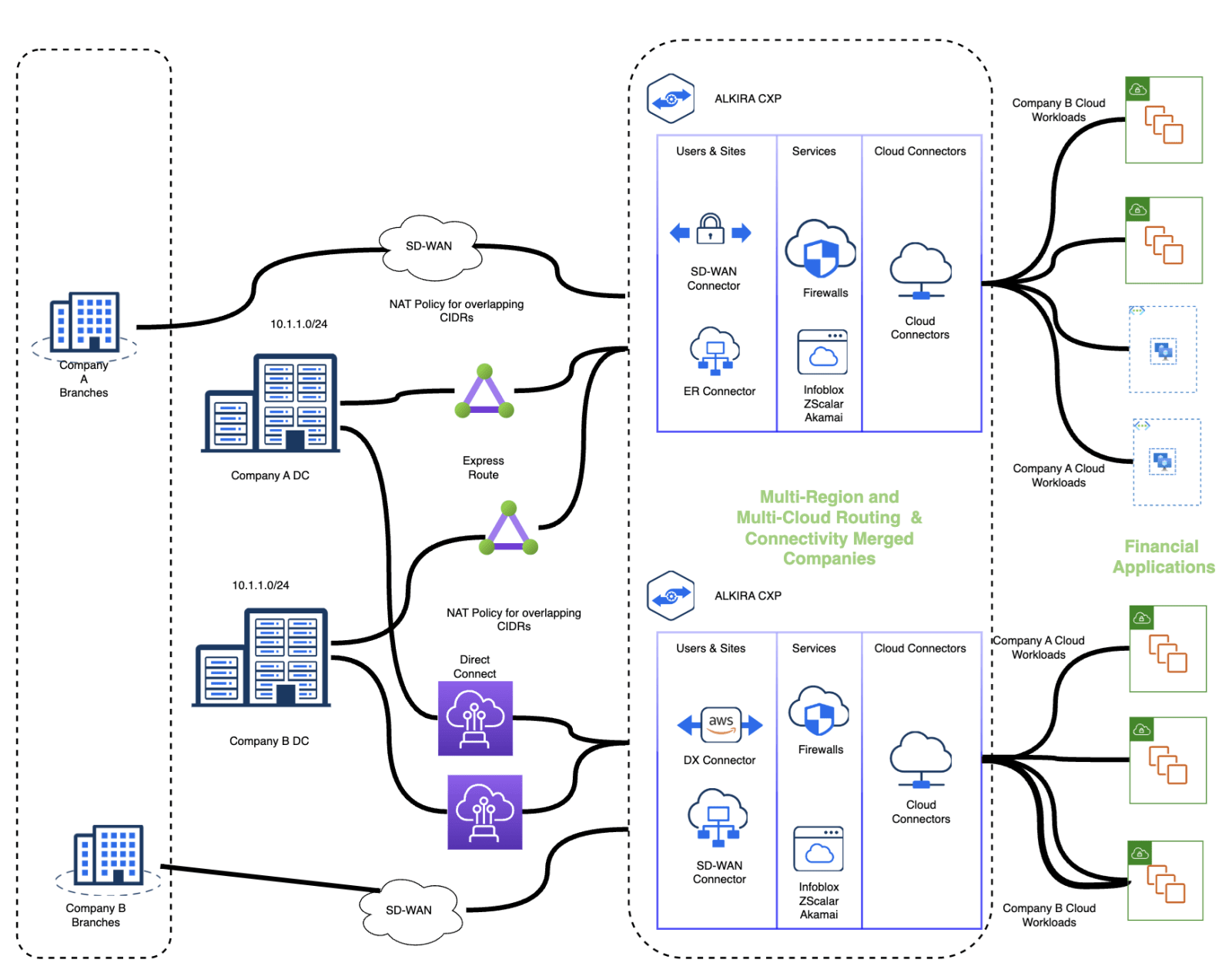 Figure 3: Alkira Topology showing connectivity options advanced NAT capabilities for Merged Companies