Bg illustration

Colocation Simplification

Replace racks, routers, firewalls, and cross-connect complexity with a cloud-native network delivered as a service. Alkira centralizes connectivity, routing, segmentation, security, and visibility across clouds, sites, and users—without rebuilding the same physical hub somewhere else

Colocation Simplification illustration

Ready to Retire Colocation Complexity?

Colocation facilities have long served as aggregation points for cloud access, branch connectivity, routing, and security. But that model brings physical infrastructure, manual cross-connects, fixed capacity, long provisioning cycles, and fragmented operations.

Alkira replaces those hardware-centric functions with a software-defined, globally orchestrated network platform. Build connectivity in minutes, enforce policy consistently, insert security services where needed, and scale without another appliance or hardware cycle. The result is a simpler operating model for cloud growth, modernization, and AI-driven demand.

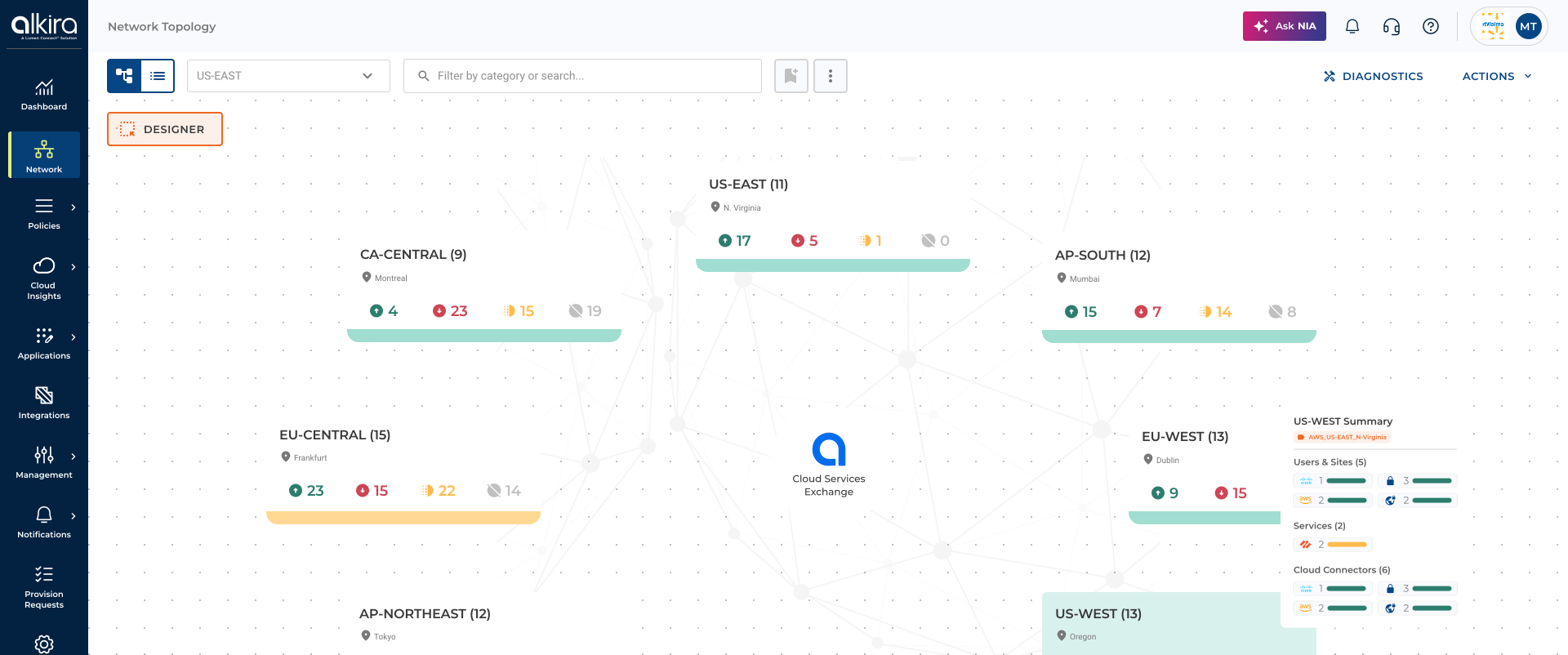
Alkira network topology screenshot

What Changes When the Colo
Is No Longer the Hub?

Physical Hub

Physical Hub

Racks of routers, firewalls, switches, and cross-connects concentrate network functions in a facility. Changes depend on hardware, provider coordination, and location-by-location configuration.

The constraint: fixed infrastructure and slow change.

Programmable Connectivity

Programmable Connectivity

Connectivity becomes an on-demand resource. Choose the underlay that fits each workload, including private and SLA-backed Lumen services where performance and reliability matter.

The foundation: robust, scalable, AI-ready infrastructure.

Cloud-Native Control

Cloud-Native Control

Alkira moves routing, segmentation, policy, traffic steering, security insertion, and visibility into a globally orchestrated platform.

The advantage: operate the network through software, not physical hubs.

Use Cases

3D Diagram showing virtualized network aggregation

Virtualize Network Aggregation

Connect data centers, branches, clouds, and users through one cloud-native fabric.

3D Diagram showing simplified cloud on-ramps

Simplify
Cloud On-Ramps

Automate connections to AWS, Microsoft Azure, Google Cloud, and other environments through a consistent model.

3D diagram showing centralized policy and security

Centralize Security & Segmentation

Create secure segments for production, migration, shared services, partners, and regulated workloads.

3D diagram showing migration

Migrate at
Your Own Pace

Keep existing colocation environments connected during transition. Validate new paths, and retire infrastructure incrementally.

Whitepaper

Modernizing Business Partner Connectivity

Modernizing business partner connectivity white paper cover

Solution Highlights

3D diagram showing one network operating model

One Operating Model

Manage connectivity, routing, segmentation, policy, and security services across clouds and on-prem environments.

3D diagram illustrating the concept no hardware

No Hardware Required

Replace dedicated colo routers, firewalls, switches, and cross-connect dependencies with cloud-native functions.

3D Diagram showing cloud network with programmable connections

Programmable by Design

Provision through an intuitive portal or automate with APIs and Terraform. Define intent once and apply policy consistently.

3D illustration showing a single pane of glass view of a network

Visibility End-to-End

See connections, routes, segments, services, and traffic behavior in one place.

How Does Alkira Compare to
Traditional Colocation Networking?

Area Alkira Traditional Colocation
Infrastructure Cloud-native network infrastructure delivered as a service Physical routers, firewalls, switches, racks, and cross-connects
Provisioning Point-and-click or API-driven deployment in minutes Hardware procurement, circuit orders, installation, and manual coordination
Operations Centralized routing, segmentation, policy, services, and visibility Distributed device configuration and fragmented provider workflows
Capacity Connectors and services scale with demand Fixed capacity sized in advance; upgrades require time and coordination
Security Default-isolated segments and centralized service insertion Appliance sprawl and location-specific policy that can drift
Change model Software-defined, programmable, and automation-ready Ticket-driven changes constrained by hardware and maintenance windows

Better Together

Alkira and Lumen: Powering the Programmable Network

Alkira and Lumen have come together to deliver the programmable, secure, and AI-ready network enterprises need to connect applications, clouds, data centers, users, and AI workloads, with greater agility, visibility, and control.

One network. Every cloud. Total Control. Globally.

FAQ


What is colocation simplification?
+
It is the modernization of network functions traditionally hosted in a colo—such as routing, cloud connectivity, security, and traffic aggregation—using cloud-native, software-defined services. The goal is to reduce physical dependencies while preserving performance, security, and control.


Can we migrate without disrupting production?
+
Yes. Existing colocation facilities can remain connected during transition. Alkira segments isolate migration, validation, and production traffic so teams can change routes and policy in controlled stages before retiring infrastructure.


How does Alkira replace colo-hosted firewalls and routers?
+
Alkira CXPs provide cloud-native routing, segmentation, policy enforcement, traffic steering, and service insertion. These capabilities are centrally managed and delivered as a service, reducing dedicated appliance sprawl.


What happens to our existing WAN, SD-WAN, and cloud connections?
+
Alkira integrates with existing environments. Sites, SD-WAN fabrics, data centers, clouds, and legacy colo hubs can attach to the Alkira fabric, supporting coexistence and phased modernization.


How does this architecture support AI initiatives?
+
AI workloads span clouds, private infrastructure, data sources, and users while demanding rapid provisioning, consistent security, and high-capacity connectivity. Alkira provides the programmable control and policy layer; Lumen can provide the robust AI-ready infrastructure beneath it.

Additional Resources

Modernization for execs white paper cover

Beyond Colocation Hubs: Network Modernization in the AI Era – for Executive Leaders – Whitepaper

Beyond Colocation Hubs: Network Modernization in the AI Era helps executive leaders understand why legacy network models are becoming a business constraint—and what to do next. As AI, cloud, and hybrid work reshape traffic patterns and risk profiles, network modernization is no longer a technical refresh. It’s a strategic operating model decision that directly impacts…
Network modernization 1b

The New Network Operating Model: Modernizing Beyond Colocation Hubs

Colo refresh is no longer a procurement decision. It’s an architectural decision. Five to six years ago, many enterprises built “cloud connectivity” by anchoring networks in colocation hubs with routers, firewalls, and cross-connects to reach cloud on-ramps. That model worked when the primary goal was access to cloud. Today, the goal is operating across cloud…
Calvin Nguyen
an abstract image of cubes moving out of a data lake

Cloud-Native Networking at Enterprise Scale: Cloud-Only Networking vs a Cross-Domain Operating Model

Most organizations evaluate solutions along two operational lenses, based on what they need to standardize and how far that standardization must extend: Both approaches use centralized control. The difference is the operational scope (cloud-only vs cross-domain) and whether segmentation and governance stays consistent as the enterprise expands. Why Now Most enterprises are no longer “cloud…
Calvin Nguyen