What is Alkira's approach to building an enterprise RAG system?
Alkira's enterprise RAG system uses a custom hybrid architecture that combines a knowledge graph and vector search within FalkorDB. This enables precise entity-based retrieval and semantic recall, ensuring low latency and complete data sovereignty. All sensitive corporate knowledge remains within Alkira's infrastructure, never exposed to external services. (Source)
Why didn’t fine-tuning alone work for enterprise knowledge retrieval at Alkira?
Fine-tuning improved language style but failed at factual recall, resulting in brittle responses and hallucinations without grounded source references. This approach could not reliably answer questions that deviated from training patterns. (Source)
What problems did off-the-shelf RAG frameworks encounter at scale?
As document volume increased, retrieval quality degraded due to context pollution, where irrelevant data overwhelmed the LLM and diluted answers. Off-the-shelf frameworks lacked granular control over ingestion and retrieval logic, making them unsuitable for complex enterprise environments. (Source)
How does Alkira’s hybrid RAG architecture ensure answer accuracy and data sovereignty?
Alkira’s dual-path retrieval (graph and semantic search) with reranking ensures responses are both relevant and grounded in verified source content. All data remains within Alkira’s infrastructure, maintaining strict data sovereignty. (Source)
What are the main components of Alkira’s custom RAG architecture?
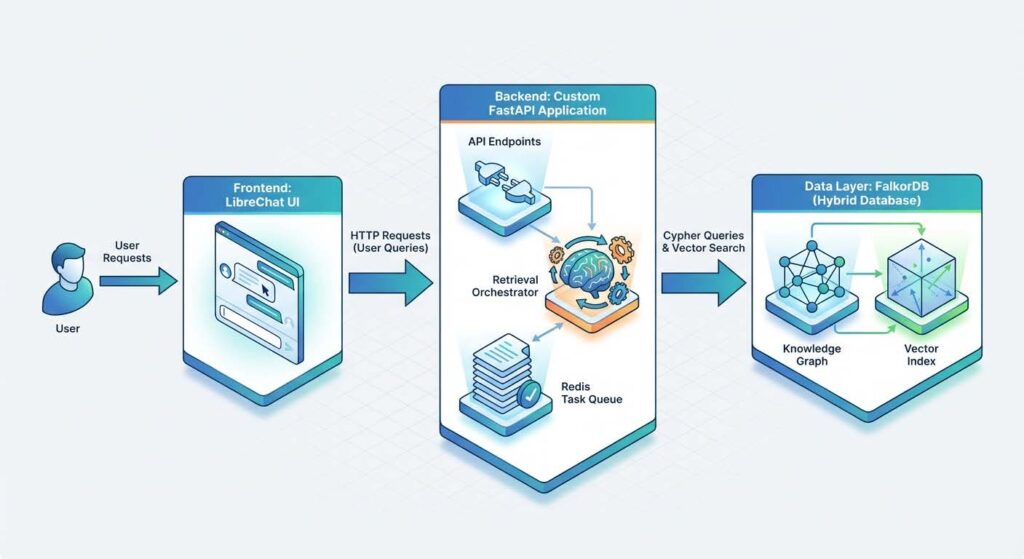
The main components are FalkorDB (knowledge graph and vector storage), a parallelized ingestion pipeline, dual-path retrieval (graph and semantic), a reranker LLM, and a synthesis LLM for final answers. (Source)
How does Alkira’s ingestion pipeline prevent context pollution?
Alkira’s ingestion pipeline uses LLM-based pre-processing, semantic chunking, entity extraction, and hybrid linking to create a rich, interconnected knowledge structure. This ensures only relevant, high-quality content is ingested and retrievable. (Source)
What is the role of the reranker LLM in Alkira’s retrieval process?
The reranker LLM performs fine-grained analysis on initial retrieval results, scoring them for relevance and filtering out remaining context pollution. The top results are then synthesized for the final answer. (Source)
How does Alkira’s system handle vague conceptual queries?
Alkira’s system uses vector search to find conceptually related documents and graph search to identify specific entities and their relationships, providing detailed, context-aware answers. (Source)
What future enhancements are planned for Alkira’s RAG platform?
Planned enhancements include automated ingestion from sources like Jira and Slack, advanced graph retrieval with temporal awareness, agentic orchestration for live data retrieval, and performance optimization with caching and corrective RAG loops. (Source)
Who is the author of Alkira’s enterprise RAG system architecture blog?
Laraib Kazi, Senior Software Engineer at Alkira, authored the blog and specializes in virtualization, networking, and GenAI-powered RAG systems for troubleshooting and knowledge retrieval. (Source)
What is context pollution in RAG systems?
Context pollution occurs when a retrieval system pulls in too many irrelevant or tangentially related documents, causing the LLM to struggle to distinguish signal from noise and leading to diluted or incorrect answers. (Source)
How does Alkira’s system improve over basic fine-tuning and off-the-shelf frameworks?
Alkira’s system provides granular control over ingestion and retrieval, uses hybrid graph and vector search, and maintains data sovereignty, overcoming the brittleness and lack of grounding found in fine-tuning and generic frameworks. (Source)
What is the role of FalkorDB in Alkira’s architecture?
FalkorDB serves as the core data layer, supporting both knowledge graph and vector embeddings in a single in-memory engine, enabling low-latency hybrid storage and high-performance graph traversal. (Source)
How does Alkira’s system handle specific technical queries?
For specific technical queries, the graph search path identifies relevant entities and retrieves exact documentation chunks, while the vector search provides additional context, resulting in comprehensive, actionable answers. (Source)
What are the infrastructure considerations for Alkira’s RAG system?
FalkorDB is in-memory, so RAM is a primary scaling cost. The multi-LLM pipeline introduces cost and latency implications that must be monitored for optimal performance. (Source)
What is the importance of schema rigidity in Alkira’s system?
The pre-defined entity schema enables powerful retrieval but requires maintenance. As new knowledge types are introduced, the schema and extraction logic may need updates to ensure continued accuracy and relevance. (Source)
How does Alkira’s system support agentic orchestration?
Alkira’s roadmap includes evolving the platform to support agentic orchestration, enabling the system to actively retrieve live data, trigger actions, and perform troubleshooting, moving beyond pure RAG to intelligent automation. (Source)
What are the key lessons learned from Alkira’s RAG system development?
Key lessons include the need for hybrid graph and vector retrieval, the importance of granular control over ingestion and retrieval, and the value of maintaining data sovereignty for enterprise knowledge systems. (Source)
Features & Capabilities
What features does Alkira offer for multicloud and hybrid cloud networking?
Alkira provides Network Infrastructure-as-a-Service (NIaaS), enabling seamless connectivity across users, business partners, clouds, and data centers. Key features include multicloud and hybrid cloud networking, integrated security (ZTNA, next-generation firewalls), global backbone-as-a-service, and business partner connectivity. (Source)
Does Alkira support integrations with other technology providers?
Yes, Alkira integrates with AWS, Azure, Google Cloud, Cisco, Fortinet, Palo Alto, Check Point, Splunk, Terraform, Infoblox, HPE Aruba, Wiz, and Itential Automation Platform. These integrations enhance connectivity, security, and automation. (Source)
Does Alkira provide an API for developers?
Yes, Alkira offers an API for integrating platform functionalities into customer systems. Detailed documentation and resources are available on Alkira's API documentation page. (Source)
What technical documentation does Alkira provide?
Alkira offers whitepapers, solution briefs, and a dedicated wiki for in-depth technical information. These resources cover firewall solutions, use cases, and platform capabilities. (Source)
What security and compliance certifications does Alkira hold?
Alkira is SOC 2 and PCI-DSS compliant, ensuring robust operational controls and protection of customer data, including cardholder information. (Source)
What are Alkira’s key product performance metrics?
Alkira reduces cloud setup time by 96%, network management time by 47%, and delivers up to 40% lower TCO compared to traditional solutions. It also enables onboarding partners 91% faster and reduces mean-time-to-resolution by 70%. (Source)
How does Alkira’s drag-and-drop interface benefit users?
Alkira’s drag-and-drop interface simplifies network design and deployment, making it accessible for non-technical users and reducing operational complexity. Customers report rapid deployment and minimal resource requirements. (Source)
What is Alkira’s vendor-agnostic approach?
Alkira allows customers to choose their preferred security and network stack components without vendor lock-in, offering unmatched flexibility compared to many competitors. (Source)
How does Alkira’s platform scale to meet business needs?
Alkira’s platform automatically adjusts network infrastructure to match bandwidth demands, ensuring rapid scalability and high-performance networking for dynamic business requirements. (Source)
Pain Points & Solutions
What common pain points does Alkira address for enterprises?
Alkira addresses intra-cloud connectivity, global connectivity inefficiencies, design sprawl, inconsistent network performance, high costs, complexity in multicloud networking, lack of visibility, scalability challenges, and operational complexity. (Source)
How does Alkira solve intra-cloud connectivity challenges?
Alkira simplifies integration between clouds, services, and providers through a unified, on-demand multi-cloud network platform, eliminating the need for physical hardware and offering seamless connectivity. (Source)
How does Alkira improve global connectivity for enterprises?
Alkira provides a high-speed, low-latency global backbone, eliminating inefficiencies from routing global traffic over independent connections and ensuring reliable, efficient traffic management. (Source)
How does Alkira reduce design sprawl and complexity?
Alkira unifies separate architectures deployed in isolation, simplifying network design and deployment with a drag-and-drop interface and single-click provisioning. (Source)
How does Alkira address performance issues in cloud networking?
Alkira ensures consistent network performance and improves user experience by leveraging its global backbone-as-a-service for scalable, reliable connectivity. (Source)
How does Alkira help manage costs and pricing unpredictability?
Alkira offers predictable pricing models, including consumption-based and commitment-based options, and reduces costs associated with regional price fluctuations and subpar performance. (Source)
How does Alkira simplify multicloud and hybrid cloud management?
Alkira’s unified platform provides centralized monitoring and control, saving time and reducing operational burdens in managing hybrid and multicloud environments. (Source)
How does Alkira provide visibility and governance for cloud networks?
Alkira offers single-pane-of-glass tools for monitoring and managing cloud networks, ensuring comprehensive visibility and governance. (Source)
Pricing & Plans
What is Alkira’s pricing model?
Alkira offers consumption-based (pay-as-you-go) and commitment-based pricing models. Pricing is tailored to each customer’s needs and influenced by network elements, connectors, firewalls, and bandwidth. Fixed hourly rates are available for specific components. (Source)
How can I get a personalized quote for Alkira’s services?
To receive a personalized quote, complete the form on Alkira’s pricing page. Alkira will provide a custom proposal based on your specific requirements. (Source)
Use Cases & Benefits
Who can benefit from Alkira’s platform?
Alkira’s platform is designed for technical roles (Network Architect, Cloud Architect, Security Architect, IT Manager/Director, CloudOps) and business leaders (VP, CTO, CIO, CISO) in companies navigating multicloud and hybrid cloud environments. (Source)
What industries are represented in Alkira’s case studies?
Alkira’s case studies cover manufacturing, retail, healthcare, financial services, media & entertainment, telecommunications, biotech, software, and aviation. (Source)
Can you share specific customer success stories using Alkira?
Yes. Michaels transformed its network across 1,400 stores in record time; Koch Industries reduced network complexity and improved agility; Warner Hotels improved networking efficiency and guest experience; SITA unified global aviation infrastructure; Chart Industries expanded globally and saved costs. (Source)
What business impact can customers expect from Alkira?
Customers can expect operational efficiency (96% reduction in cloud setup time), cost savings (up to 40% lower TCO), scalability, enhanced security, rapid global connectivity, improved service quality, and measurable ROI. (Source)
How long does it take to implement Alkira’s platform?
Proof of concept can be implemented in as little as 4 hours, and full production deployment is typically completed in about 8 weeks. (Source)
How easy is it to start using Alkira?
Alkira offers a user-friendly drag-and-drop interface, comprehensive training resources, and rapid deployment, making onboarding seamless and efficient. (Source)
Competition & Comparison
How does Alkira compare to traditional cloud networking solutions?
Alkira delivers up to 40% lower TCO, reduces cloud setup time by 96%, and network management time by 47%. Its vendor-agnostic approach and integrated security provide flexibility and robust protection not typically found in traditional solutions. (Source)
Why should a customer choose Alkira over alternatives?
Alkira offers ease of use, rapid deployment, measurable ROI, vendor-agnostic flexibility, integrated security, global backbone-as-a-service, and comprehensive visibility, making it a leader in simplifying multicloud networking and enhancing operational efficiency. (Source)
How does Alkira’s platform differ for different user segments?
Technical users benefit from simplified network design and reduced operational burdens, business users gain measurable ROI and scalability, and security teams leverage integrated ZTNA and next-generation firewalls for robust protection. (Source)
What are Alkira’s competitive advantages in the market?
Alkira’s true abstraction layer, vendor-agnostic approach, ease of use, global backbone-as-a-service, integrated security, comprehensive visibility, and measurable ROI set it apart from competitors. (Source)
Company Information & Vision
What is Alkira’s vision and mission?
Alkira’s vision is to simplify and enhance networking across multicloud and hybrid cloud environments, transforming enterprise connectivity through innovative Network Infrastructure-as-a-Service solutions. (Source)
What key information should customers know about Alkira?
Alkira is a leading cloud networking company, recognized as a Gartner Cool Vendor and ranked among the fastest-growing companies in North America. It has a strong leadership team and is dedicated to delivering innovative solutions and customer success. (Source)
In any large enterprise, corporate knowledge is both a critical asset and a monumental challenge. It’s scattered across wikis, ticketing systems, design documents, and support channels—often locked in silos, written by different teams with different terminology. The holy grail has always been a centralized, intelligent system that can bridge these silos, understand a user’s intent, and provide accurate, context-aware answers. We embarked on a journey to build such a system.
This wasn’t a straightforward path. We started with the prevailing trends, hit significant walls, and had to re-evaluate our core assumptions. Additionally, data sovereignty was a non-negotiable requirement – managed off-the-shelf RAG solutions would require sending our sensitive corporate data to third-party services, which was unacceptable. All our data needed to remain within Alkira’s infrastructure at all times. This article documents our architectural journey, from the failures of basic fine-tuning and off-the-shelf RAG frameworks to the design of a custom, high-performance hybrid RAG system.
Early Attempts and Lessons Learned
Our initial goal was to create a general-purpose, GPT-style chatbot for internal knowledge.
The real-world constraints were clear: the system had to handle vague questions and scale across a knowledge base of ever-increasing size and complexity.
Part 1: The Fine-Tuning Fallacy
Our first instinct was to try fine-tuning several open-source models (Llama3- 8B, Qwen3-8B, Mistral-7B). The process was standard: generate Q/A pairs from our docs and train. The results were consistently subpar; the models could only provide correct answers if we phrased the prompt in a very specific way. Fine-tuning adjusts a model’s weights to specialize its style and vocabulary, but it does not function as a queryable memory. This leads to two critical failures:
Brittleness: The model learns statistical patterns, not factual relationships. It cannot reliably answer questions that deviate from the patterns it was trained on.
Lack of Grounding: The model has no direct reference to the source material when generating an answer. This makes it impossible to verify accuracy and easy to introduce hallucinations.
We quickly put a pause on this approach. Fine-tuning may have its place for narrow, targeted applications, but it was not the solution for a broad, dynamic knowledge base.
Part 2: The RAG Rabbit Hole with Off-the-Shelf Frameworks
The logical next step was Retrieval-Augmented Generation (RAG). The principle is sound: retrieve relevant documents first, then use an LLM to synthesize an answer based on that context.
Our initial exploration of existing open source tools and frameworks proved difficult, with convoluted setups and unresolved issues that blocked even basic proof-of-concepts.
We eventually landed on LightRAG, which showed promise.
Prototype v0.1:Using LightRAG as-is with Neo4j and Qdrant, we ingested a small set of documents. The results were promising enough to continue.
Prototype v0.2:We forked LightRAG and introduced more sophisticated features: LLM-driven semantic chunking, contextual embeddings, and dynamic entity extraction. However, when we scaled up the knowledge base from ~100 to ~3000 documents, the system broke down.
The answers became unsatisfactory, often containing irrelevant information. We were facing a classic RAG problem: context pollution.
Context pollution occurs when a retrieval system, overwhelmed by the volume of data, pulls in too many irrelevant or tangentially related documents. When this noisy context is fed to the generator LLM, it struggles to distinguish signal from noise, leading to diluted, incorrect, or nonsensical answers.
So, we concluded that an off-the-shelf framework, while great for getting started, is ultimately too generic and rigid. It doesn’t offer the granular control over ingestion and retrieval logic required to combat context pollution in a complex enterprise environment. We realized that to succeed, we had to build from scratch.
Part 3: The Turning Point – A Hybrid Proof of Concept (v0.3)
Before committing to a full custom build, we created another rapid prototype to validate our new architectural hypotheses.
Knowledge Graph: We shifted to FalkorDB and used its graphrag-sdk for quick ingestion.
Vector Database & Hybrid Search: We used Qdrant to experiment with a powerful Hybrid Vector Search. For each document chunk, we generated:
A Dense Vector (Qwen3-8B-Embedding) to capture semantic meaning (e.g., understanding that “how do I find a VM?” is similar to “can I look up a server?”).
A Sparse Vector (SPLADE) to capture keyword importance, crucial for matching exact, specific terms (e.g., a function name like “get_instance_by_id” or an error code “CX-8042”).
Querying Backend: We built a minimal FastAPI server using gemini-2.5-flash for inference.
The results were outstanding. With ~5,000 documents, the quality was dramatically better. This validated our path.
Key Lessons from v0.3:
Validation: The hybrid Graph + Vector retrieval strategy was unequivocally correct.
Insight: In hindsight, we realized that supporting both sparse and dense vectors added significant query latency. It was a powerful technique, but a single, high-quality dense vector proved sufficient for our needs, especially in conjunction with graph based queries.
Discovery: We were using two databases because we hadn’t realized FalkorDB could handle vectors natively. This discovery directly led to the more streamlined, single-database architecture of v0.4.
With our core assumptions validated, we were ready to start building production-ready system.
The Solution: A Custom, Hybrid RAG Architecture (AKGPT v0.4)
Our final architecture, codenamed AKGPT, was designed around a central principle: total control. This control extends to data sovereignty – ensuring that all sensitive corporate knowledge remains within Alkira’s infrastructure and is never exposed to external services.
1. The Data Layer: FalkorDB at the Core
The foundation is FalkorDB, a high-performance fork of Redis. We chose it for two key reasons:
Low-Latency Hybrid Storage: It natively supports both a Knowledge Graph and Vector Embeddings in a single in-memory engine, eliminating the complexity and network overhead of syncing two separate databases.
High-Performance Graph Traversal: Under the hood, it represents the graph using sparse matrices. This allows for CPU cache-friendly sequential memory access during traversals, making it significantly faster than traditional graph databases that rely on pointer chasing.
2. The Ingestion Pipeline: Building Hybrid Knowledge
This is where we solve the context pollution problem. Our ingestion process is designed to create a rich, interconnected knowledge structure that supports multiple retrieval strategies. It’s a manually triggered, parallelized workload managed by a Redis queue.
Pre-processing & Cleaning: First, an LLM acts as a gatekeeper, reviewing every input file to ensure it contains viable technical content (e.g., troubleshooting, bug fixes, configurations). It filters out administrative chatter, PII, and other noise. This is our first line of defense against garbage-in, garbage-out.
Semantic Chunking: Cleaned files are chunked based on semantic meaning, not fixed token counts, to ensure that context is preserved within each chunk.
Entity & Relationship Extraction: An LLM analyzes each chunk to extract key entities and their relationships based on a pre-defined schema (e.g., (Service)-[:HAS_PARAMETER]->(Parameter)).
Vector Embedding: The exact same text chunk is then embedded into a dense vector using Qwen3-embedding-8b (4096 dimensions).
Hybrid Linking: This is the most critical step. We create a unified knowledge structure by combining semantic and conceptual information in our graph database. The process involves establishing connections between different data representations to enable multiple retrieval pathways.
This hybrid approach creates explicit links between conceptual information and its source context, allowing our system to traverse from abstract concepts to their grounding documentation. This design enables both precise entity-based retrieval and broader semantic search within a single, cohesive framework.
3. The Retrieval Engine: A Dual-Path Hybrid Search
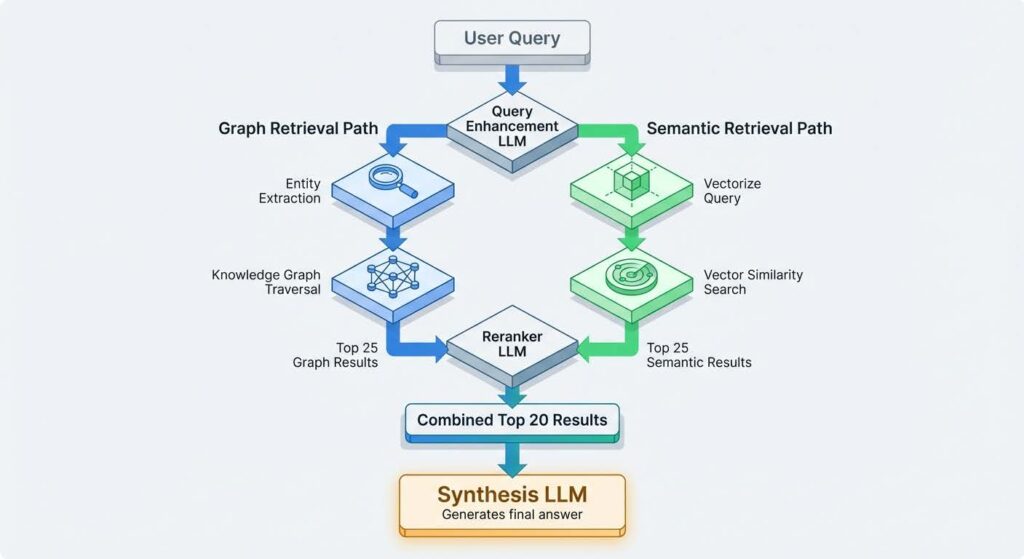
Step 1:Query Enhancement
The user’s prompt is intercepted and expanded by an LLM armed with a detailed system prompt containing foundational knowledge. For example, the system prompt knows: “Alkira’s network is composed of Cloud Exchange Points (CXPs). A CXP connects to cloud resources via Connectors.” This reframes the user’s potentially vague query into a more technically precise question.
Step 2:Parallel Retrieval
The enhanced query is dispatched to two retrieval processes that run in parallel:
Path A:Graph Retrieval (Precision)
Entity Extraction: We extract entities from the enhanced query using the same schema as our ingestion pipeline.Graph Traversal: The engine searches the Knowledge Graph for these entities and traverses the relationships to retrieve required chunks.
Path B:Semantic Retrieval (Recall)
Embedding: The enhanced query is vectorized using the same model as our ingestion pipeline.
Vector Search: A vector similarity search is performed against the chunk embeddings indexed in FalkorDB.
Step 2.5:The Importance of the Reranker
The initial retrieval in both paths is optimized for speed and recall, meaning it casts a wide net and may still include noise. The retrieved results are then passed to a more specialized Reranker LLM (Qwen3-reranker-8b). This model’s sole job is to perform a more computationally expensive, fine-grained analysis, scoring the initial results for relevance against the specific query and filtering out any remaining context pollution. We take the top 10 from each path.
Step 3:Synthesis
The top 20 unique results (10 Graph +10 Semantic) are combined into a single, rich context. This context is then passed to our final generator LLM (gemini-2.5-flash), which synthesizes a comprehensive answer.
Verification
The system now excels where previous versions failed.
Vague Conceptual Query: “How does our billing system handle multi-region failover?”
The vector search path finds documents conceptually related to “billing” and “failover.”
The graph search path finds specific entities like BillingService, FailoverPolicy, and traverses to the exact chunks describing their interaction.
The final synthesis provides a detailed architectural explanation.
Specific Technical Query: “What’s the command to restart the auth-service in production?”
The graph search path immediately identifies the auth-service entity and finds chunks from runbooks or wikis containing restart commands.
The vector search provides additional context, perhaps explaining the impact of a restart.
The final answer gives the command and relevant warnings.
Caveats & Future Enhancements
This is not a simple, plug-and-play solution. It requires significant custom development and expertise in graph databases, vector search, and LLM orchestration. Key considerations include:
Infrastructure: FalkorDB is in-memory, so RAM is a primary scaling cost.
Cost & Latency: The multi-LLM pipeline (cleaning, extraction, enhancement, reranking, synthesis) has cost and latency implications that must be monitored.
Schema Rigidity: The pre-defined entity schema is powerful but requires maintenance. As new types of knowledge are introduced, the schema and extraction logic may need to be updated.
Our roadmap is focused on maturing this platform into a fully automated, agentic system:
Automated Ingestion: Scheduling data downloads from sources like Jira, Confluence, and Slack.
Advanced Graph Retrieval: Incorporating temporal awareness (weighting newer information higher) and expanding searches to “2-hop” neighbors to capture indirect relationships.
Agentic Orchestration: Evolving from a pure RAG system to an agent that can actively retrieve live data or trigger actions, and perhaps even perform troubleshooting.
Performance Optimization: Implementing a corrective RAG loop for self-critique and a caching layer for frequently asked questions.
Conclusion
Building an enterprise AI assistant turned out to be quite the architectural adventure. We started with off-the-shelf frameworks which were great for getting started, but we quickly hit their limits – they trade fine-grained control for convenience. When you’re dealing with complex, ever-changing knowledge bases, a custom hybrid approach really shines. By mixing the exactness of a Knowledge Graph with the wide reach of semantic vector search, we created a system that sidesteps the context pollution problems that trip up so many RAG implementations, while maintaining complete data sovereignty within Alkira’s infrastructure. Sure, the dual-path retrieval adds some complexity, but it means our users get answers that are both thorough and firmly rooted in our collective know-how.
Why didn’t fine-tuning alone work for enterprise knowledge retrieval?+
Fine-tuning improved language style but failed at factual recall, leading to brittle responses and hallucinations without grounded source references.
What problems did off-the-shelf RAG frameworks encounter at scale?+
As document volume increased, retrieval quality degraded due to context pollution, where irrelevant data overwhelmed the LLM and diluted answers.
What makes Alkira’s hybrid RAG architecture different?+
It combines a knowledge graph and vector search in a single FalkorDB engine, enabling precise entity-based retrieval alongside semantic recall with low latency.
How does this approach ensure data sovereignty and answer accuracy?+
All data stays within Alkira’s infrastructure, and dual-path retrieval with reranking ensures responses are both relevant and grounded in verified source content.
Laraib Kazi is a Senior Software Engineer at Alkira, where he supports customers as a member of the escalations team. Specializing in virtualization, networking and complex problem resolution, Kazi is currently building GenAI and LLM-powered RAG systems to automate troubleshooting and knowledge retrieval. A hands-on "fixer of problems" at heart, he also develops custom CLI tools to diagnose issues and turn repetitive challenges into automated solutions.
Enterprise networks are expected to run 24/7, and the teams responsible for them need visibility wherever work happens. Cloud environments, partner connections, security services, and provisioning workflows are constantly changing. When something needs attention, network and operations teams need a fast way to understand what happened, assess impact, and take the right next step. That...
Enterprises are moving quickly on AI, but many are still running networking models designed for a slower, more centralized and static era. Today’s network has to connect clouds, data centers, campuses, branches, partner environments, and increasingly private AI infrastructure while enforcing consistent policy across all of it. That creates a new operational reality: every new...
The Digital Operational Resilience Act (DORA) is reshaping how financial institutions in the European Union manage operational risk related to information and communication technology (ICT). As the regulation takes effect, organizations must ensure that their critical ICT service providers support strong operational resilience, risk management, and oversight capabilities. For technology providers supporting financial institutions, this...