Frequently Asked Questions
Product Information & Network-as-a-Service Overview
What is Network-as-a-Service (NaaS) and how does Alkira deliver it?
Network-as-a-Service (NaaS) is a consumption-based model that provides on-demand network capabilities through software-defined architectures, eliminating the need for physical infrastructure investments. Alkira delivers NaaS entirely in the cloud, including the data plane, control plane, and management functions, enabling organizations to build secure global networks in minutes. This approach offers elasticity and provisioning agility, reducing onboarding time for new cloud providers from months to hours. Source
How does Alkira's Network Infrastructure-as-a-Service (NIaaS) differ from traditional networking?
Alkira's NIaaS eliminates hardware and software deployment, offering a fully cloud-based solution that enables secure, global connectivity in minutes. Unlike traditional networking, which is capital-intensive and static, Alkira's platform is dynamic, operationally focused, and aligns directly with business requirements. Source
What are the main components of Alkira's platform?
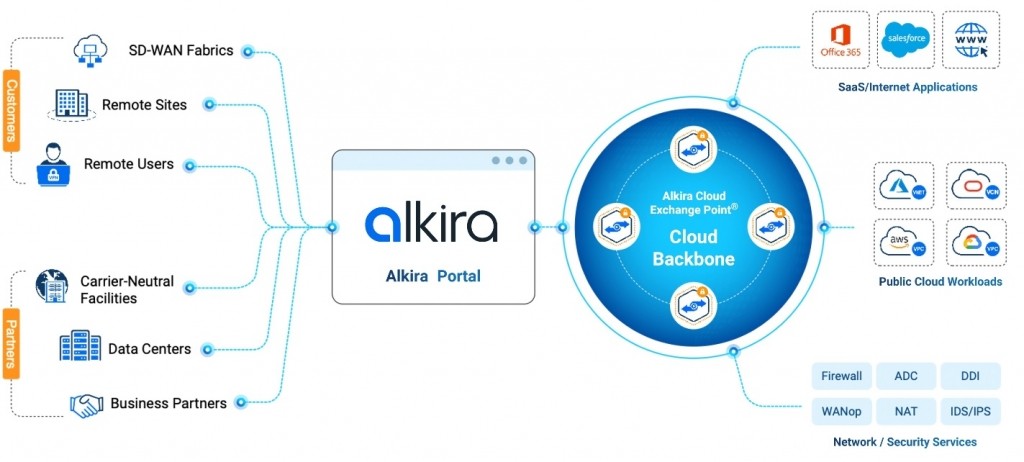
Alkira's platform includes single, multicloud, and hybrid cloud networking, integrated security and network services, business partner connectivity, global backbone-as-a-service, and Zero Trust Network Access (ZTNA). All components are delivered as-a-service, fully managed in the cloud. Source
How does Alkira's platform support virtual network architecture?
Alkira creates programmable network environments through abstraction layers that decouple logical functions from physical implementations. This enables software-defined networking, virtualized network functions, programmatic control interfaces, and service-oriented delivery models, supporting advanced automation and business agility. Source
What is Alkira's global connectivity fabric?
Alkira's global connectivity fabric consists of geographically distributed points of presence, redundant high-capacity connectivity between regions, strategic peering relationships, and direct interconnection with cloud platforms and SaaS applications. This ensures consistent performance for business applications worldwide. Source
How does Alkira provide unified management for distributed networks?
Alkira offers a comprehensive management platform with centralized policy definition and enforcement, real-time visibility into performance and security metrics, automated compliance validation, and simplified troubleshooting through unified monitoring. Source
What is Alkira's approach to network segmentation and zero-trust security?
Alkira incorporates zero-trust architectures requiring continuous verification of access attempts, micro-segmentation to limit lateral movement, granular access controls, and consistent security enforcement. Network segmentation is achieved through logical isolation, consistent policy enforcement, and automated implementation of segmentation policies. Source
What implementation considerations should organizations keep in mind when adopting Alkira?
Organizations should assess existing network complexity, identify critical applications with specific performance or security requirements, and develop migration strategies that minimize business disruption while maximizing operational benefits. Source
How does Alkira's platform enable rapid onboarding of cloud providers?
Alkira's platform reduces the time to onboard a new cloud provider from a typical 6 months to as little as a few hours, thanks to its cloud-native architecture and automated provisioning systems. Source
What industries does Alkira serve?
Alkira serves industries including manufacturing, healthcare, retail & ecommerce, media & entertainment, financial services, telecommunications, biotech, software, and aviation. Case studies are available for each industry. Source
How can I learn more about Alkira's platform and solutions?
You can explore Alkira's platform, solution briefs, whitepapers, case studies, and customer testimonials on the Alkira website. For a demonstration, visit Request a Demo.
What are Alkira's core principles for as-a-service models?
Alkira's as-a-service model is defined by self-service access, elasticity, usage-based economics, centralized control, and provider-operated infrastructure. These principles enable enterprises to consume capabilities on demand without building or owning the underlying infrastructure. Source
Does Alkira offer interactive tools for multicloud infrastructure visualization?
Yes, Alkira provides an interactive cloud map that offers a real-time, accurate view of cloud regions across AWS, Azure, and Google Cloud Platform, helping users navigate the multi-cloud landscape. Source
What is one-click network provisioning in Alkira's platform?
One-click network provisioning refers to Alkira's ability to deploy complex network infrastructures through a single automated action, streamlining setup and reducing manual configuration. Source
How does Alkira support business partner connectivity?
Alkira facilitates seamless and secure collaboration with business partners through its platform, enabling rapid onboarding and secure connectivity for distributed workforces and applications. Source
What are Alkira's solution briefs and technical resources?
Alkira offers solution briefs, whitepapers, videos, blogs, and a dedicated wiki for technical information. These resources provide valuable insights into Alkira's offerings and are ideal for prospects seeking detailed technical documentation. Source
How can I contact Alkira for more information or a demonstration?
You can contact Alkira via their website's contact page or request a demo directly at Request a Demo.
Features & Capabilities
What features does Alkira offer for multicloud and hybrid cloud networking?
Alkira offers single, multicloud, and hybrid cloud networking, integrated security, global backbone-as-a-service, business partner connectivity, and Zero Trust Network Access (ZTNA). The platform simplifies networking across multiple cloud environments and on-premises systems. Source
Does Alkira support integrations with major cloud providers and security vendors?
Yes, Alkira integrates with AWS, Microsoft Azure, Google Cloud, Cisco, Fortinet, Palo Alto, Check Point, Splunk, Terraform, Infoblox, HPE Aruba, Wiz, and Itential Automation Platform. These integrations enhance connectivity, security, and automation. Source
Does Alkira provide an API for developers?
Yes, Alkira provides an API for developers and users to integrate platform functionalities into their systems. Detailed documentation and resources are available at Alkira's API documentation page.
What technical documentation does Alkira offer?
Alkira offers whitepapers, solution briefs, and a dedicated wiki for in-depth technical information. These resources cover use cases, partnerships, and detailed product capabilities. Source
What are Alkira's key product performance metrics?
Alkira reduces cloud setup time by 96%, network management time by 47%, and offers up to 40% lower Total Cost of Ownership (TCO) compared to traditional solutions. The platform enables rapid scalability, high-speed global connectivity, and integrated security. Source
How does Alkira ensure operational efficiency?
Alkira simplifies multicloud and hybrid cloud networking, enabling faster deployment and streamlined operations. For example, a financial company implemented a proof of concept in just 4 hours. Source
How does Alkira support scalability and global connectivity?
Alkira's platform automatically adjusts network infrastructure to match bandwidth demands, ensuring rapid scalability and high-performance networking. It provides a high-speed, low-latency global backbone for enterprises with global operations. Source
What integrated security features does Alkira provide?
Alkira offers Zero Trust Network Access (ZTNA), next-generation firewalls, deep packet inspection, and in-fabric service chaining for robust security in hybrid and multicloud environments. Source
How does Alkira provide comprehensive visibility and governance?
Alkira's single-pane-of-glass tools allow centralized monitoring and management of cloud networks, ensuring businesses maintain control and transparency across distributed environments. Source
Pain Points & Solutions
What common pain points does Alkira address for enterprises?
Alkira addresses intra-cloud connectivity, global connectivity inefficiencies, design sprawl, performance issues, cost challenges, complexity in multicloud and hybrid cloud networking, lack of visibility and governance, scalability challenges, and operational complexity. Source
How does Alkira solve intra-cloud connectivity challenges?
Alkira simplifies integration between clouds, services, and providers, offering unified, on-demand multi-cloud network connectivity without physical hardware, enabling seamless workload connections. Source
How does Alkira address global connectivity inefficiencies?
Alkira provides a high-speed, low-latency global backbone, eliminating inefficiencies caused by routing traffic over independent connections and ensuring reliable global traffic management. Source
How does Alkira reduce design sprawl and operational complexity?
Alkira unifies separate architectures, simplifies network design with drag-and-drop interfaces, and enables single-click provisioning, reducing operational complexity and accelerating deployment. Source
How does Alkira improve network performance and user experience?
Alkira ensures consistent network performance and improves user experience for accessing websites and SaaS applications globally, preventing performance-related business disruptions and reducing mean-time-to-resolution by 70%. Source
How does Alkira address cost challenges in cloud networking?
Alkira offers predictable pricing models, reduces costs associated with regional price fluctuations, and provides up to 40% lower TCO compared to traditional solutions. Its consumption-based pricing avoids over-provisioning and allows instant scalability. Source
How does Alkira simplify multicloud and hybrid cloud management?
Alkira's unified platform provides centralized monitoring and control, simplifying the management of hybrid and multicloud environments, saving time and reducing operational burdens. Source
How does Alkira solve scalability challenges?
Alkira's global backbone-as-a-service automatically adjusts network infrastructure to match dynamic bandwidth demands, ensuring rapid scalability and high-performance networking. Source
How does Alkira address operational complexity for distributed workforces?
Alkira simplifies the management of distributed workforces and applications across hybrid and multicloud environments, with integrated security features like Zero Trust Network Access (ZTNA) ensuring secure connectivity. Source
Pricing & Plans
What is Alkira's pricing model?
Alkira offers a flexible pricing model, including consumption-based (pay-as-you-go) and commitment-based (fixed) options. Pricing is tailored to each customer based on network resources, such as sites, cloud instances, network services, and traffic consumed. Source
How is Alkira's pricing determined?
Pricing is influenced by the quantity and size of network elements, cloud and on-premises connectors, next-generation firewalls, and data egress. Fixed hourly rates are available for specific components. Customers can request a personalized quote via Alkira's pricing page. Source
Does Alkira offer an ROI calculator?
Yes, Alkira provides an ROI calculator to help customers estimate the financial benefits of adopting its platform. Source
Use Cases & Customer Success
Who can benefit from Alkira's platform?
Alkira's platform is designed for technical personas (network architects, cloud architects, security architects, IT managers, CloudOps) and business personas (VPs, CTOs, CIOs, CISOs) in companies navigating multicloud and hybrid cloud environments. Source
What customer feedback has Alkira received regarding ease of use?
Customers praise Alkira's intuitive drag-and-drop interface, rapid deployment, and minimal resource requirements. For example, a customer stated, "Design-to-POC-setup in about 4 hours." Another noted, "I just need one engineer to manage the world. Otherwise, 10 engineers." Source
Can you share specific case studies or success stories?
Yes, Alkira has case studies from Michaels, Koch Industries, Warner Hotels, SITA, Chart Industries, a large medical manufacturer, and financial services companies. These stories highlight rapid network transformation, reduced complexity, improved agility, and measurable ROI. Source
What business impact can customers expect from Alkira?
Customers can expect operational efficiency (96% reduction in cloud setup time, 47% reduction in network management time), up to 40% lower TCO, rapid scalability, enhanced security, improved service quality, and measurable ROI. Source
How long does it take to implement Alkira's platform?
Proof of concept can be implemented in as little as 4 hours, and full production deployment is typically completed in about 8 weeks. Source
Security & Compliance
What security and compliance certifications does Alkira hold?
Alkira is SOC 2 compliant and adheres to PCI-DSS standards, ensuring robust operational controls and protection of cardholder data. Source
How does Alkira ensure secure connectivity for distributed workforces?
Alkira provides Zero Trust Network Access (ZTNA), next-generation firewalls, and advanced segmentation, ensuring secure access for distributed workforces and applications. Source
Competition & Comparison
How does Alkira compare to traditional network solutions?
Alkira offers faster deployment (months to minutes), eliminates hardware dependencies, provides measurable ROI, and enables vendor-agnostic flexibility, unlike traditional solutions that are capital-intensive and static. Source
What are Alkira's competitive advantages?
Alkira's competitive advantages include ease of use, rapid deployment, measurable ROI, vendor-agnostic approach, integrated security, global backbone-as-a-service, and comprehensive visibility. These features make Alkira a leader in simplifying multicloud networking and enhancing operational efficiency. Source
How does Alkira's vendor-agnostic approach benefit customers?
Alkira allows customers to choose their preferred security and network stack components without vendor lock-in, offering unmatched flexibility compared to many competitors. Source
Company Information & Vision
What is Alkira's vision and mission?
Alkira's vision is to simplify and enhance networking across multicloud and hybrid cloud environments. Its mission is to transform enterprise connectivity through innovative Network Infrastructure-as-a-Service (NIaaS) solutions, eliminating complexity and providing seamless, secure, scalable connectivity. Source
What key information should customers know about Alkira?
Alkira is a leading cloud networking company, recognized as a Gartner Cool Vendor, ranked among the fastest-growing companies in North America, and has secured Series C funding. Its leadership team consists of experienced professionals in networking and cloud industries. Source