
Network Infrastructure-as-a-Service Resources

Learn how to accelerate your multicloud journey with Alkira

Globe-min
Filter
Filter
Categories
Content Type
network cloud exploding with connections

Cloud-Native Networking at Enterprise Scale: Scope & Blast Radius

Cloud-only networking works until the enterprise shows up. The moment your network scope includes branches, data centers, SaaS, partners, and multi-cloud traffic, “cloud networking” stops being the problem statement. The problem becomes how to provide enterprise-wide connectivity and consistent policy, delivered with a controlled blast radius. And this is where the architecture divide becomes obvious....
Calvin Nguyen
an abstract image of cubes moving out of a data lake

Cloud-Native Networking at Enterprise Scale: Cloud-Only Networking vs a Cross-Domain Operating Model

Most organizations evaluate solutions along two operational lenses, based on what they need to standardize and how far that standardization must extend: Both approaches use centralized control. The difference is the operational scope (cloud-only vs cross-domain) and whether segmentation and governance stays consistent as the enterprise expands. Why Now Most enterprises are no longer “cloud...
Calvin Nguyen
a grid of purple network clouds floating over a digital plane

Cloud-Native Networking at Enterprise Scale: Segmentation and Policy

The challenge is not creating policy. It is keeping policy consistent over time. In a single cloud, segmentation is often manageable. Many enterprises can rely on cloud-native controls or a cloud-only tool when the scope is limited to one cloud and a handful of regions. Teams can build rules, test them, and keep them reasonably...
Calvin Nguyen
Network-mod-10

The New Network Operating Model: The Path Forward

From physical networking infrastructure to a cloud operating model. Across this series, one conclusion is clear: network modernization is no longer optional, and it is no longer only a network team concern. Many enterprises built colo-centered architectures to accelerate early cloud adoption. In the AI and multi-cloud era, those same architectures often become the bottleneck....
Calvin Nguyen
Abstract light pattern illustrating -the objections that stall network modernization

The New Network Operating Model: The Objections That Stall Modernization

Why resistance to network modernization is rarely technical. By the time network modernization reaches executive discussion, the technical case is usually settled. Architects understand the limitations of colo-anchored networks. Security teams see policy drift across hybrid and multi-cloud environments. AI teams feel latency, cost, and operational friction daily. And still, decisions stall. That stall rarely...
Calvin Nguyen
Abstract light pattern illustrating - Measuring Network Modernization with key metrics across operations, cost, risk, and AI performance

The New Network Operating Model: Measuring Network Modernization

How enterprises prove network modernization actually worked. Network modernization rarely fails because of technology. Its success is undermined because organizations can’t often prove the impact. Executives do not keep funding diagrams. They keep funding measurable outcomes: When modernization lacks clear metrics, it looks like infrastructure churn. When it is measurable, it becomes a business program...
Calvin Nguyen
Abstract illustration of cloud and network connections representing network modernization use cases in the new network operating model.

The New Network Operating Model: Network Modernization Use Cases

A colo exit starts as a necessity. Very few enterprises decide to use traditional models like colos as a strategic initiative. Modernization is usually reactive. It starts when the business demands outcomes the current architecture cannot deliver fast enough, consistently enough, or at a cost the organization can defend. Across industries, the same forcing functions...
Calvin Nguyen
Abstract network diagram illustrating a network modernization strategy using phased, parallel adoption to reduce migration risk.

The New Network Operating Model: The Modernization Strategy That Reduces Risk

Why Network Modernization Must Be Phased, Parallel, and Low-Risk. For many enterprises, network modernization does not fail on technology. It fails on migration risk. The drivers are well understood: Even with a clear business case, leaders delay action because modernization is often associated with disruption. The key principle Successful modernization does not require a big-bang...
Calvin Nguyen
Network-mod-5a

The New Network Operating Model: Economic Alignment for AI-Era Networking

Fixed-cost networks restrict network agility in the AI era. Network modernization ultimately succeeds or fails on economics. Not list price. Not cost per megabit. Economic alignment. In the AI era, demand is volatile. Regions ramp fast. Data moves constantly between clouds, data centers, and edge locations. If the network is funded and built on fixed...
Calvin Nguyen
Network-mod-4a

The New Network Operating Model: Operational Simplicity Is the Scaling Constraint in Network Modernization

Performance can be engineered. Complexity compounds. For years, network modernization has centered on speed, bandwidth, and latency. Those metrics still matter, but they are rarely what holds enterprises back. At scale, operations fail before performance does. As networks spread across clouds, regions, partners, and AI workloads, the leadership question shifts from “How fast is the...
Calvin Nguyen
Network-mod-3a

The New Network Operating Model: Security From Day 0

You cannot bolt trust onto a hyper-distributed network. Multi-cloud, SaaS, business partners, and AI data pipelines have turned the network into a continuously changing set of traffic paths. In reality, the old model of building connectivity first, then bolt security on top, breaks down fast. When segmentation is implemented as a patchwork of cloud-specific constructs,...
Calvin Nguyen
Network-mod-2c

The New Network Operating Model: Network Infrastructure-as-a-Service

What Network Infrastructure as a Service Actually Is Network Infrastructure as a Service (NIaaS) is a cloud-delivered network fabric consumed on demand. Instead of building and maintaining hubs, overlays, and backbone capacity, enterprises define segmentation and connectivity intent, and the service delivers secure, deterministic connectivity across clouds, data centers, and distributed locations. Problem: Traditional Modern...
Calvin Nguyen

See Network Infrastructure-as-a-Service in Action!

Schedue a 30-minute demonstration with a cloud specialist today and we’ll show you how to:

  • Cut cloud network provisioning time from months to minutes
  • Get simple, as -a-service consumption for your global cloud network with no upfront costs or CAPEX
  • Ensure enterprise grade security when moving to cloud


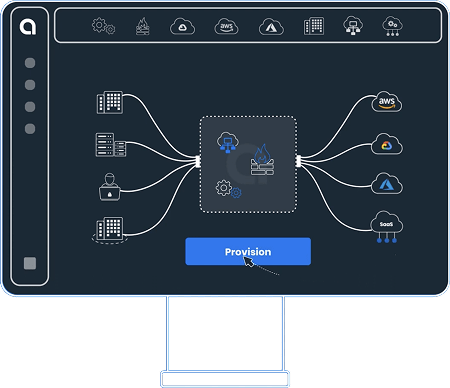
dashboard

Slash Cloud Network Deployment Time & TCO

Just draw your new cloud network on a simple canvas, and with one click watch it come to life.